One of the finest works to emerge from Japan’s early medieval age is The Tale of the Heike(『平家物語』). It recounts the wars of the late twelfth century. Though now esteemed as a literary classic, it was originally handed down through oral performance. The work is pervaded by the Buddhist ideal of mujō(無常)—the conviction that nothing is eternal and that all things are subject to impermanence.
During the twelfth century, the Taira clan(平氏,Heishi) held the reins of government in Japan. Through flourishing trade with the Song dynasty of China, they amassed immense wealth. Their leader, Taira no Kiyomori(平清盛), was not only the supreme commander of the warrior class but also rose to the highest civil office of Dajō-daijin (Chancellor of the Realm、太政大臣). By marrying his daughter to Emperor Takakura(高倉天皇) and placing their son upon the throne as Emperor Antoku(安徳天皇), he brought unprecedented political power into the hands of his house.
Around 1168, Kiyomori rebuilt the shrine buildings of Itsukushima Shrine(厳島神社) in present-day Hiroshima, which thereafter became the tutelary shrine of the Taira.
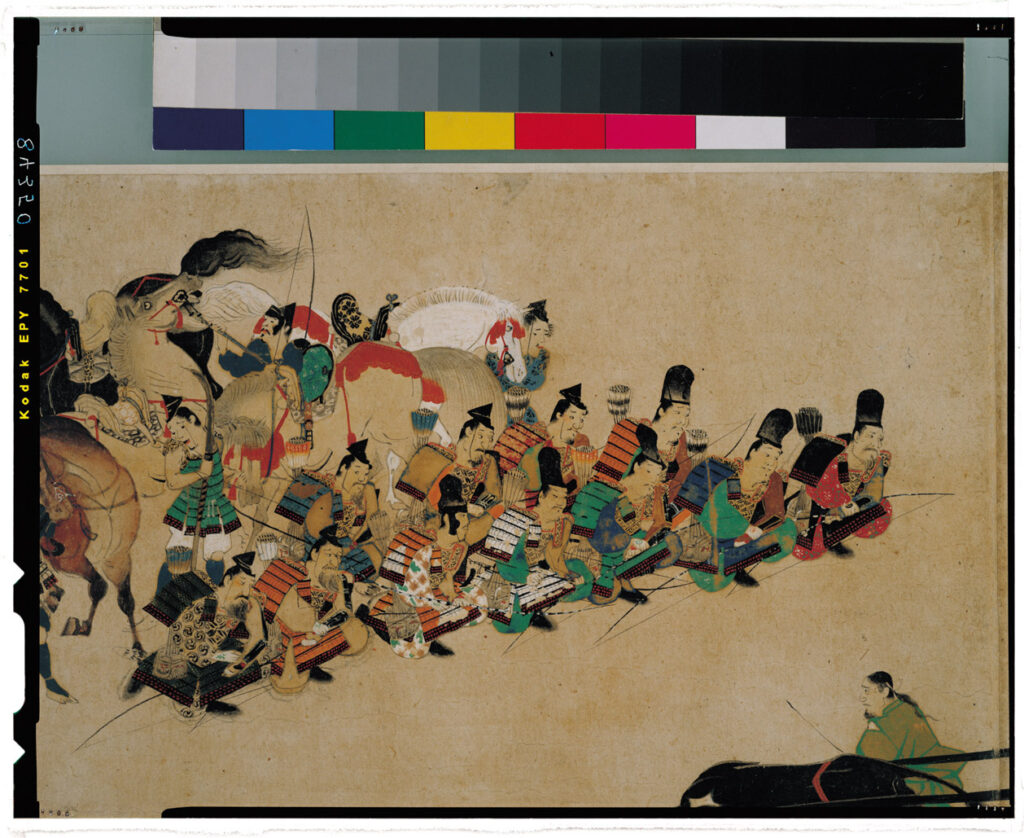
As authority grew increasingly concentrated in the Taira, opposition spread throughout the country. Foremost among their rivals was the Minamoto clan(源氏,Genji) whose mounted warriors of eastern Japan were renowned for their mastery of the bow. The Taira, by contrast, relied chiefly upon naval power, while many of their young nobles had grown accustomed to courtly life and gradually lost their martial vigor.
After Kiyomori’s death, the balance of power collapsed. Led by the brilliant general Minamoto no Yoshitsune(源義経), the Minamoto advanced upon Kyoto, forcing the Taira to retreat westward. The final struggle was fought at sea, culminating in the Battle of Dan-no-ura(壇ノ浦の合戦). Realizing that defeat was inevitable, many Taira warriors fell in battle or took their own lives. The noblewomen aboard their ships likewise cast themselves into the waves. Among those who perished was the child Emperor Antoku.